

Build a Strategic Editorial Calendar
Building a strategic editorial calendar is now essential for managing digital communication effectively. In an environment where content channels are multiplying and competition for attention is intense, publishing content on the fly is no longer enough.
A well-designed editorial calendar helps you anticipate publications, align content with business, marketing, and SEO goals, and turn content creation into a structured, measurable, and collaborative process.
1. Why build a strategic editorial calendar
An editorial calendar is more than a list of dates and topics. When built strategically, it helps you:
- ensure consistent publishing
- structure your content strategy over the mid and long term
- avoid redundant or improvised content
- optimize internal resources
- improve SEO performance through a clear thematic vision
In short, it transforms content production into a controlled and scalable process.tif.
2. The pillars of an effective editorial calendar
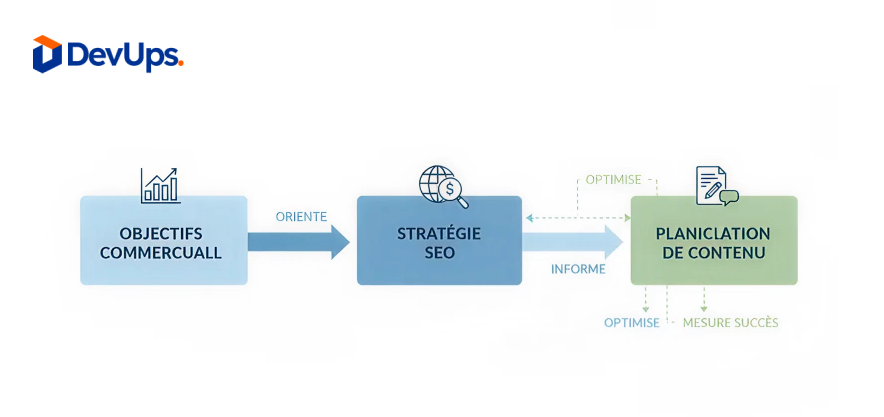
Alignment with business goals
Every piece of content should serve a clear objective: brand awareness, lead generation, trust-building, retention, or conversion.
A strategic editorial calendar always starts with one question: why are we publishing this content?
SEO-driven thematic consistency
Planning content in advance allows you to work on keywords progressively and logically. It supports topic clusters, strengthens internal linking, and improves how search engines understand your website.
Consistent publishing rhythm
Planning content in advance allows you to work on keywords progressively and logically. It supports topic clusters, strengthens internal linking, and improves how search engines understand your website.
👉 Related article : SEO fundamentals for 2025
Consistent publishing rhythm
Publishing less but better and more consistently is often more effective than producing content intensively without structure. An editorial calendar helps adapt the rhythm to your team’s real capacity.
3. How to structure a strategic editorial calendar
A high-performing editorial calendar relies on a few key elements:
- content title or topic
- distribution channel (blog, newsletter, LinkedIn, etc.)
- target audience or persona
- primary and secondary keywords
- content format (article, guide, video, case study…)
- publication date
- owner or responsible team member
This structure simplifies tracking and improves coordination, especially in cross-functional teams.
4. Tools to manage a strategic editorial calendar
There is no single perfect tool. The right choice depends on your organization’s maturity.
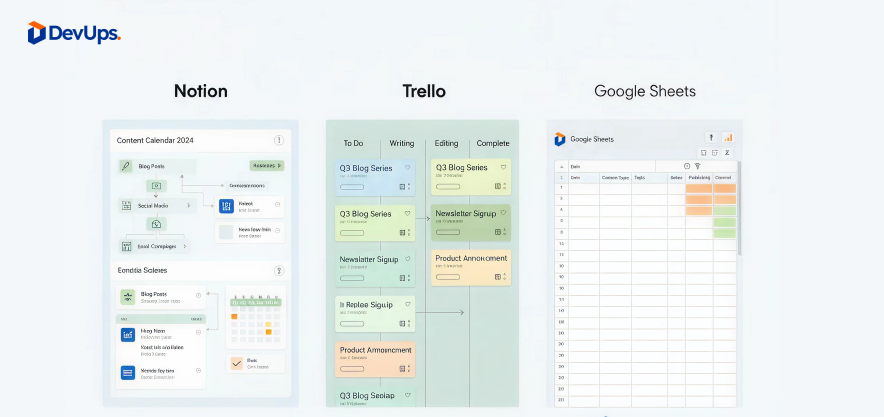
- Notion: ideal for centralizing content, briefs, and validations
- Trello / Asana: excellent for visual and collaborative workflows
- Google Sheets: simple and effective for getting started
- Marketing automation tools: useful for syncing content planning and distribution
👉 Also read : How to choose the right collaborative tools
5. Collaboration and team organization
A strategic editorial calendar is also a collaboration tool. It makes it clear:
- who creates the content
- who reviews and validates it
- when it will be published
- on which channel
This transparency reduces friction, improves communication, and increases overall content quality.
6. Automate and analyze to improve performance
Once your calendar is in place, the next step is optimization through measurement.
Key metrics to track:
- traffic generated
- engagement rate
- conversions
- SEO performance of content
Automation helps save time by scheduling posts, setting internal reminders, and syncing with CRM or analytics tools.
7. DevUps and a strategic editorial approach
At DevUps, we help organizations structure and execute their content strategies—from editorial planning to operational delivery.
Our approach focuses on:
- aligning content, SEO, and business objectives
- selecting tools adapted to your organization
- building a clear, sustainable methodology
Conclusion
Building a strategic editorial calendar means shifting from reactive content creation to a structured, performance-driven approach. It is also a powerful lever for improving visibility, internal collaboration, and the impact of every publication.
In today’s demanding digital landscape, editorial strategy is a long-term competitive advantage.
👉 Need help structuring your editorial calendar? Contact DevUps
Latest Insights and Tips
Start building your digital ecosystem today. Get in touch with our team to discuss your project.

Automatically connect your CRM to your emails
March 4, 2026
Automatically connecting your CRM to your emails has become essential for businesses looking to save time, improve customer tracking, and…

Which tools to use for an effective digital audit
February 23, 2026
Conducting an effective digital audit is a critical step to understand the overall performance of your online presence. Before optimizing…

Digital onboarding: How to successfully welcome a new employee
February 16, 2026
Digital onboarding has become a strategic priority for organizations looking to successfully integrate new employees, especially in hybrid and remote…
Low-code vs No-code: Key Differences
January 26, 2026
Low-code vs no-code? These two approaches are changing the way digital tools and applications are built. By reducing the need…

Automating HR Processes: Concrete Use Cases
January 20, 2026
HR process automation has become a strategic lever for companies looking to gain efficiency, reduce operational costs, and improve the…

How to choose the right collaboration tools for a high-performing team
January 13, 2026
In a professional environment where hybrid work, remote collaboration, and cross-functional teams have become the norm, choosing the right collaboration…